
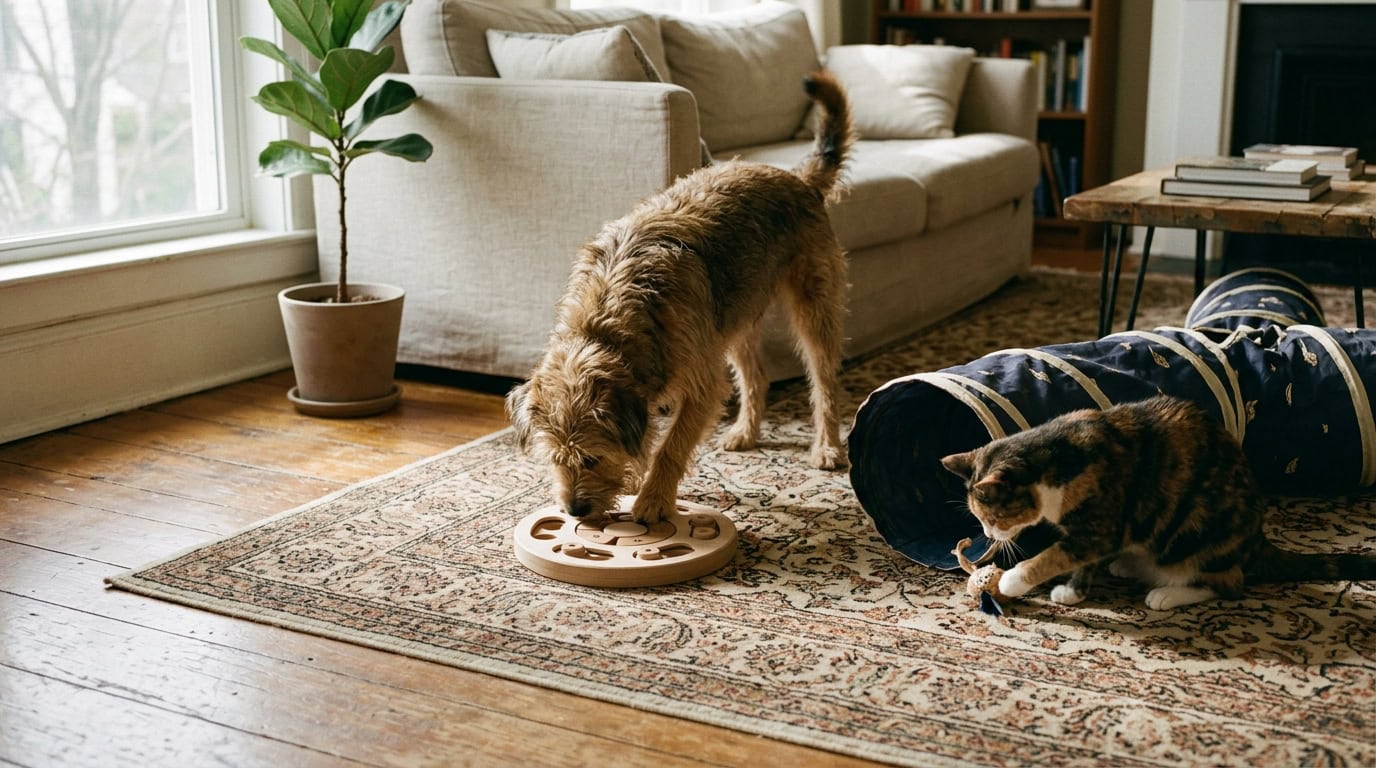
There is a version of responsible pet ownership that exists entirely outdoors: trail runs with a golden retriever, leash-training drills in the park, cat harness adventures through suburban streets. PawPresents has covered plenty of it. But weather is indifferent to our best intentions, apartments don’t come with yards, and the reality of a February ice storm is that nobody is going anywhere. What happens to your pet’s physical and mental health on those days matters just as much as what happens on the good ones.
Indoor enrichment is not a consolation prize. For apartment dwellers, pet owners in extreme climates, and anyone whose routine has been upended by life, it is simply the primary mode. The good news is that a confined space does not have to mean a bored animal, and a bored animal, as any owner who has come home to chewed furniture or an inexplicably emptied bookshelf can confirm, is a problem worth preventing.
Why indoor stimulation isn’t optional
Physical exercise gets most of the attention, but mental stimulation is what genuinely tires a dog or cat out. A dog that has spent 20 minutes working through a puzzle feeder is meaningfully more settled than one that took a quick loop around the block. The same principle applies to cats, who in the wild would spend hours hunting, stalking, and problem-solving for food they could obtain in minutes.
When that cognitive load disappears, animals fill the gap themselves. For dogs, understimulation tends to manifest as destructive chewing, excessive barking, or the kind of frantic energy that makes a quiet evening impossible. Cats express it differently: incessant vocalization, furniture scratching that goes beyond normal claw maintenance, or the clinginess and distress we covered in detail in our guide to separation anxiety in cats. The behavioral signals are different across species, but the root cause is often the same. An under-stimulated animal is an animal trying to cope.
The fix is rarely more outdoor time. It is a deliberate, varied program of enrichment that addresses both the physical and the cognitive.
For dogs: working the brain before the body
Puzzle feeders and scent work
The simplest entry point for indoor dog enrichment costs almost nothing. Take whatever your dog normally eats from a bowl and put it somewhere less convenient. Scatter kibble across a snuffle mat so your dog has to nose through fabric fibers to find each piece. Stuff a Kong with food and freeze it. Invest in a commercial puzzle feeder that requires your dog to slide panels, flip lids, or spin compartments to access a reward.
These are not tricks or gimmicks. Puzzle feeders are a well-documented tool for canine mental stimulation, engaging problem-solving behaviors that dogs are genuinely motivated to perform. The difficulty levels vary widely, so a dog who masters a beginner puzzle in three minutes can be graduated to something that requires more steps and more patience.
Scent work is the more sophisticated version of the same impulse. Dogs navigate the world primarily through smell, and channeling that ability into a structured search game is one of the most effective forms of indoor enrichment available. The American Kennel Club formally recognizes scent work as a sport with its own titling program, but you don’t need to compete to benefit from the principles. Start by hiding a high-value treat under one of three overturned cups and letting your dog indicate which one. Progress to hiding treats in progressively more complex locations around a single room, then multiple rooms. The dog works, thinks, succeeds, and settles.
Adapting outdoor training for indoor use
If you have done any leash training with your dog, indoors is where that work can be maintained and deepened without a square foot of outdoor space. Recall games are particularly well-suited to a hallway or living room: call your dog from across the house, reward enthusiastically, repeat. The goal is the same as outdoor recall practice, building a reflexive, reliable response to their name, but the environment adds its own dimension. Indoor spaces have different distractions and different acoustics, and a dog that responds reliably inside is building a habit that transfers.
For dogs who are still working through leash manners, indoor desensitization exercises have genuine value. A retractable lead like the ANCOOLE Retractable Dog Lead allows you to practice controlled movement through the house, working on loose-lead habits in a low-stakes setting. Our leash training guide covers the foundational techniques, and almost all of them translate directly to indoor practice with minor adjustments for space. The skills built indoors compound once you return outside.
Hide-and-seek is underrated as a training tool. Have your dog sit and stay while you hide in another room, then call them to find you. It works the stay, the recall, and the dog’s problem-solving ability simultaneously, and it costs nothing.
For cats: enrichment beyond the toy basket
Wand toys and interactive play
Cats are obligate hunters. Their play is not recreational in the way a dog’s fetch is recreational; it is a simulation of predatory behavior, and without it, they stagnate. A wand toy with a feather or fabric lure at the end is the most direct way to engage that instinct. The movement matters: erratic, prey-like movement that stops and starts provokes the stalk-and-pounce sequence cats need to complete.
Two 10-minute wand toy sessions per day are enough to make a measurable difference in a cat’s energy and mood. The key is not duration but genuine engagement. A wand toy waved distractedly in one direction while you watch television is not the same thing as an interactive session where the “prey” hides behind furniture, freezes, and darts unpredictably.
Window perches and passive enrichment
Not every enrichment activity requires owner participation. A window perch positioned at a bird feeder or a busy street gives an indoor cat hours of low-intensity stimulation: birds, squirrels, passing pedestrians, weather. It sounds modest, but for a cat confined to four walls, an animated view is a meaningful quality-of-life upgrade. Window perches are widely available and most mount without drilling, making them as practical for renters as they are for homeowners.
Cat TV is the digital version of the same concept. Videos of birds, fish, and small mammals play on loop and reliably hold the attention of cats who respond to screen movement. It is not a substitute for interactive play, but as a supplement during working hours it earns its keep.
Cat wheels and physical exercise
For high-energy cats, particularly younger ones and breeds like Bengals or Abyssinians that were not really designed for sedentary apartment life, a cat exercise wheel addresses a need that wand toys and window perches simply cannot. Cat wheels function like a feline treadmill: the cat runs on the wheel under their own motivation, burning energy that would otherwise go into wall-climbing and 3 a.m. sprinting.
They are a significant investment and require some floor space, but for the right cat they shift from luxury to necessity. Most cats need an introduction period with treats and patience before they take to the wheel independently, and not every cat will. That caveat is worth stating plainly before purchase.
Leash skills for indoor cats
Cat leash training is frequently treated as purely an outdoor ambition, but the desensitization and harness-comfort work that precedes any outdoor walk is inherently indoor work. Getting a cat used to wearing a harness, then to having a leash attached, then to moving with that weight and restriction, all happens inside before it happens anywhere else. Our cat leash roundup and leash training guide address both the equipment and the method. Indoor practice sessions that reward calm harness-wearing build the foundation that makes outdoor walks possible later, and are themselves a form of enrichment.
The budget question
There is a comfortable amount of money you can spend on indoor enrichment, and there is essentially nothing. Both approaches work.
On the free end: scatter feeding, indoor recall games, hide-and-seek, cardboard boxes, paper bags with the handles removed, wand toys improvised from a stick and a piece of ribbon, and rotation of whatever toys your cat or dog already owns to restore novelty. Rotation alone, cycling toys in and out of a drawer on a weekly basis rather than leaving everything accessible, reliably extends the useful life of existing items.
On the worthwhile investment end: a quality snuffle mat, a multi-level puzzle feeder, a window perch, and for the right cat, an exercise wheel. These are not interchangeable, and the right product for one animal may be irrelevant to another. A dog with no food motivation is unlikely to be transformed by a puzzle feeder. A cat who ignores the window is not going to be converted by a bird feeder view. Knowing your animal’s actual motivators, food, movement, social attention, predatory play, is more valuable than any single product recommendation.
Consistency over intensity
The same principle that makes outdoor training effective applies indoors: short, consistent sessions outperform occasional marathon efforts. Ten minutes of scent work daily does more than an hour of it once a week. The routine itself becomes part of the enrichment, as animals who know when to expect engagement are less likely to manufacture their own.
Bad weather and confined spaces will come regardless of what we’d prefer. The pets who weather them best are the ones whose owners have built indoor enrichment into the routine before it becomes urgent, not as an emergency measure, but as a permanent part of how they care for their animals.
Leave a Reply