
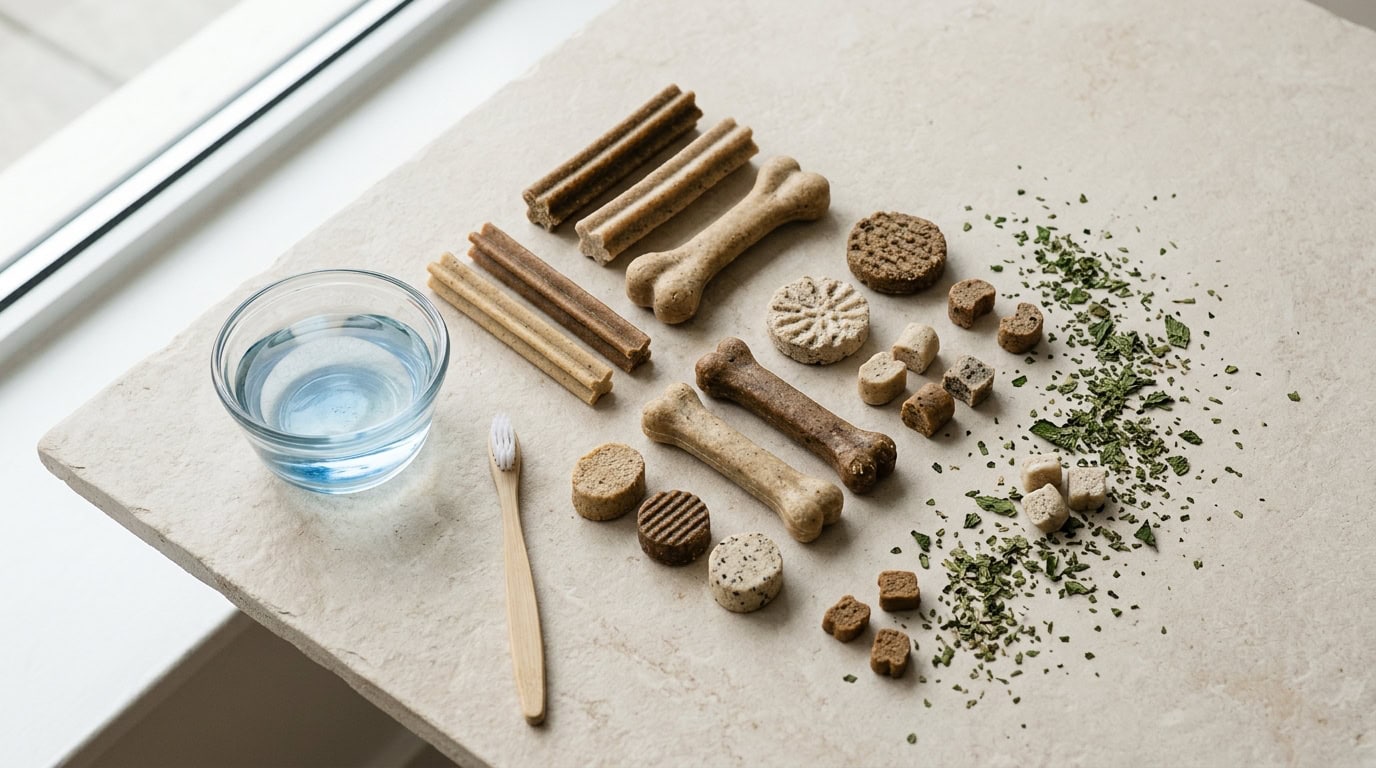
Passive dental products have quietly taken over a significant slice of the pet aisle, and it’s not hard to understand why. Brushing your dog’s teeth every day is an admirable goal. Brushing your cat’s teeth every day borders on performance art. For busy owners, dental chews, water additives, and sprays represent a genuinely appealing middle ground: something effective that doesn’t require pinning a reluctant animal to the bathroom floor.
The question worth asking is whether that appeal is backed by anything real.
Our complete guide to pet dental health made the case for consistent home care and regular veterinary check-ups as the foundation of a healthy mouth. That position stands. What the guide didn’t cover in depth is the growing category of passive maintenance products that sit between the toothbrush and the dental chair. Two years on, with dental disease continuing to climb across both dogs and cats, that gap is worth closing.
What “dental” on a label actually means
Very little, by default. The word “dental” on pet product packaging carries no standardized regulatory requirement. A treat can be labeled a dental chew because it’s vaguely shaped like a toothbrush, or because the texture is harder than a standard biscuit, without any clinical evidence that it reduces plaque or tartar.
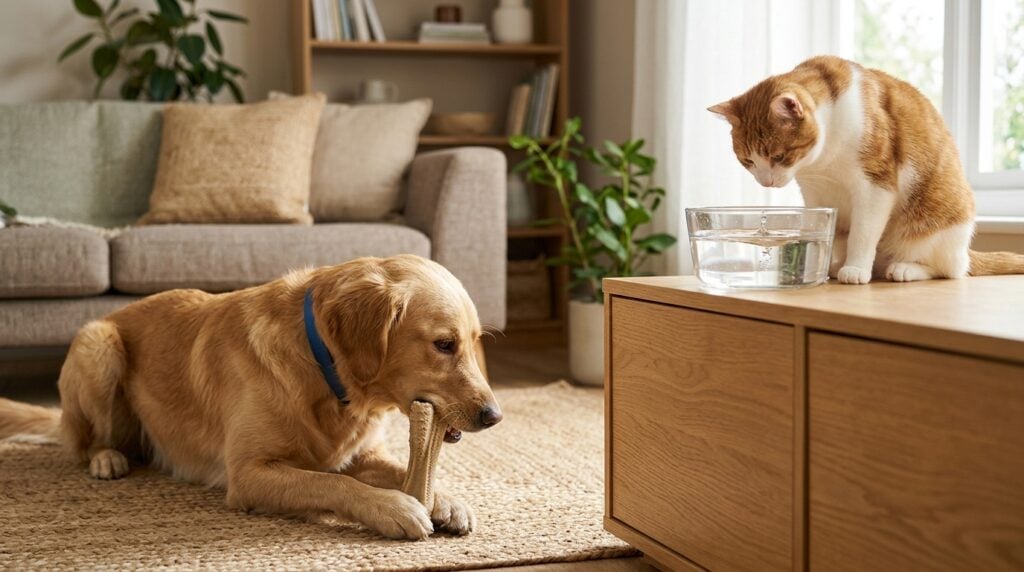
The benchmark that separates meaningful products from marketing is the Veterinary Oral Health Council (VOHC) seal. The VOHC is an independent body that evaluates submitted clinical data against predetermined standards for reducing plaque, tartar, or both. Products that meet those standards earn VOHC acceptance. Products that don’t may still be fine treats, but they haven’t proven they do what their packaging implies.
When shopping for any dental product, the VOHC seal is the single most useful filter you have. The council maintains an updated list of accepted products organized by species.
Dental chews: the strongest evidence, with caveats
Among passive dental care options, chews have the most robust body of evidence. Mechanical abrasion against tooth surfaces as a dog chews is a straightforward concept, and the better-formulated products combine that physical action with ingredients designed to inhibit tartar formation.
Greenies are among the most widely recognized VOHC-accepted dental chews for dogs, available in sizes ranging from petite to large. The texture is intentionally pliable rather than rock-hard, which matters: excessively hard chews (think antlers, weight-bearing bones, nylon chews) carry a real risk of tooth fracture, particularly in aggressive chewers. Greenies’ formulation aims to compress and flex around the tooth rather than resist it.
Whimzees also carry VOHC acceptance and take a different approach with their unusual geometric shapes, designed to maximize surface contact during chewing. They’re vegetable-based, which appeals to owners watching ingredient lists, and the texture sits in that same functional middle zone: firm enough to work, yielding enough to be safe.
Milk-Bone Brushing Chews are widely available and marketed around the brushing metaphor, with a twisted shape intended to reach multiple tooth surfaces. They’re a popular entry point and widely stocked, though owners should verify current VOHC status independently when purchasing, as acceptance listings are updated periodically.
One universal caveat: chews only contact the teeth they physically touch. A dog who gulps rather than chews, or who works only one side of the mouth, will get partial benefit at best. Size appropriateness matters too. A large chew swallowed quickly by a small dog is a choking hazard, not a dental treatment.
The feline blind spot
Cat dental disease is at least as prevalent as it is in dogs, but almost every conversation about home dental care defaults to canine examples. Cats develop plaque, tartar, and periodontal disease on the same timeline as dogs, and they are considerably less cooperative about having anything done about it.
The VOHC does maintain accepted product listings for cats, and it’s worth consulting that list directly. Dental chews formulated for cats exist, though the category is smaller than the dog equivalent. Water additives and oral rinses are often a more practical first step for cats because they require no active cooperation beyond drinking.
For owners who want to work toward direct oral contact, the RUMGR Dog Finger Toothbrush style of tool, worn over the finger rather than held like a wand, can make exploratory brushing feel less like a confrontation for both parties. It’s not a cat-specific product, but it’s worth considering for cats who tolerate handling reasonably well. Progress is gradual; the goal is tolerance over time.
Water additives: low effort, modest effect
Water additives occupy the lowest-friction position in the passive dental toolkit. Add a measured amount to the water bowl, and the active ingredients circulate through the mouth every time your pet drinks. For cats especially, this is often the path of least resistance.
Oxyfresh Pet Dental Water Additive is one of the more recognized options in this category, formulated to help reduce bacteria that contribute to plaque and bad breath. It’s odorless and tasteless, which matters enormously: cats in particular will simply stop drinking if their water tastes or smells wrong.
The realistic expectation for water additives is modest. They are not a substitute for mechanical cleaning. Where they add genuine value is as a daily maintenance layer for pets who resist all other approaches, or as a complement to a broader routine.
Vetri-Science Perio Support takes a slightly different approach as a powder supplement rather than a liquid additive, formulated to support gum tissue and reduce bacterial load. It’s worth a conversation with your veterinarian before introducing any supplement, particularly for cats or dogs with existing health conditions.
Buying guide: quick reference
- By size: Match chew size to dog weight precisely. Undersized chews for large dogs are swallowing hazards; oversized chews frustrate small dogs and reduce effective chewing time.
- By age: Puppies and senior dogs have more sensitive teeth and gums. Look for softer formulations and confirm age appropriateness on the packaging.
- By chewing style: Aggressive power chewers need flexible chews, not hard ones. Gulpers need supervision or chews sized to prevent swallowing whole.
- For cats: Prioritize VOHC-accepted products and low-intervention formats. Water additives are usually the easiest starting point; dental treats formulated for cats are a secondary option.
- The non-negotiable: None of these products replace brushing, and none of them replace professional cleaning. As the dental health guide covers in detail, home care and veterinary oversight work together. Passive products fill gaps in that routine; they don’t close them entirely.
Leave a Reply